
PANELIST(S)
 Deb Rozeboom, Project Manager - Public Safety GIS Services, GeoComm
Deb Rozeboom is a Product Manager with GeoComm and is dedicated to helping GIS professionals and 9-1-1 agencies understand the importance of GIS in 9-1-1 and NG9-1-1 systems. In her 17-year career at GeoComm in Public Safety GIS she has worked with countless cities and counties as well as State and Federal government agencies to educate, plan, and construct project approaches to align with system requirements and industry standards. She also contributes to shaping those industry standards through workgroup participation and leadership, and this helps her stay current on evolving trends and technologies. She is passionate about taking her experiences and communicating and educating the public safety and GIS professional communities through webinars and presentations to relay technical information and best practices in an approachable way.
Brian Rosen, Principal, Brian Rosen Technologies, LLC
Barry C. Hutchins, Special GIS Projects, County of Lycoming Public Safety
Christian Przybylek, Geospatial Analyst for 9-1-1, PEMA
Christian Przybylek is the Geospatial Analyst for the Pennsylvania Emergency Management Agency’s (PEMA’s) 911 Office. Prior to coming to PEMA, Christian worked in the conservation field, serving as the geospatial analyst and stewardship project manager for the Lancaster Conservancy. Christian is a seasoned non-profit professional and has over 10 years of experience in collaborating on projects with local, state, federal, and commercial stakeholders, and partners. Christian holds an M.A. in Geography and Urban Studies and a Graduate Certificate in Geographic Information Systems from Temple University and a B.A. in Political Science from Eastern University.
Christian’s focus is to coordinate GIS efforts between county partners, PEMA, Comtech and GeoComm to support NG911 service.
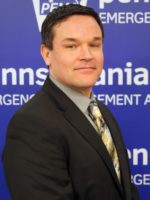 Jeffrey Boyle, Deputy Director of 9-1-1, PEMA
Jeffrey Boyle is the Deputy Director for 911 at the Pennsylvania Emergency Management Agency (PEMA), where he is responsible for coordinating Pennsylvania’s transition to a statewide next generation 911 (NG911) system. Jeff has developed a close partnership with the Pennsylvania 911 community which has led to significant accomplishments to improve 911 systems across the Commonwealth in areas such as standards adoption, plan development, GIS enhancements, and addressing aging systems within county 911 centers.
Jeff has implemented many needed reforms in the 911 Program to streamline business processes and improve oversight of 911 funding. Since 2016, Jeff has managed over $1.7 billion of 911 surcharge revenue to sustain and improve current 911 systems while maintaining Pennsylvania’s ability to fund the largest technological upgrade in decades to our 911 system with the implementation of NG911.
Jeff holds a Bachelor of Science degree in Business Administration from the California University of Pennsylvania. He has over eighteen years of experience in progressively responsible accounting, audit, and information technology management positions with the Commonwealth.
Bill Shertzer, 9-1-1 Program Manager, PEMA
 Based in Austin, TX, Amy Farley is a Software Architect/Geospatial Technologist with 20+ years of experience in object-oriented design and web application development. AMy's experience includes developing web mapping applications using open-source frameworks; AWS and GCP cloud computing experience including software and infrastructure migration projects.
 Nick DiPaolo has more than 20 years of experience working on Technology and Geospatial Information Systems (GIS) projects. He has managed GIS application development and data projects and, in positions, has provided QA/QC, performed SQL administrative tasks, and conducted training seminars and workshops for both GIS and non-GIS users. He has led several Next Generation 911 upgrade projects and is a member of the NENA GIS Data Model Working Group which is responsible for updating the model.
 Amanda Wagner is a Meteorologist at the National Weather Service in State College, PA. She is a GIS analyst for her weather forecast office and leads the GIS program there. She seeks to combine geography and weather to visualize and understand meteorological phenomena.
 Originally from Shanghai, China, Yiru Zhang is a third-year student in the Master of Landscape Architecture program graduating in May 2021. Her master’s capstone project redesigns a play system spatially to support active, engaged, meaningful, and socially interactive play for children in underserved urban neighborhoods. Co-presenting with her advisor Ken Tamminga, they will give an oral presentation at the 17th CUPUM International Conference held virtually in Helsinki, Finland in June 2021. She was also a finalist in the 2021 ULI Hines Student Competition which addresses housing affordability, equity, transportation, and resilience that reflects Kansas City’s vision for a thriving mixed-use, mixed-income area.
 Jonathan Greiner is an accomplished geographic information systems (GIS) professional with 27 years of work experience providing GIS/IT solutions in the following sectors: transportation, environmental, water utilities, wastewater utilities, stormwater utilities, planning and zoning, and local government. Mr. Greiner has experience with the development of IT-based custom GIS applications for over one hundred large and small clients to address complex problems. Jonathan served as technical lead for the PTC Stormwater Asset Management Program (SWAMP) project., helping to coordinate system integrations, data model development, blueprinting and workflow diagram development, unit testing, user acceptance testing, and system training.
 Nicholas Noss is a Registered Professional Engineer with over 8 years of design and project management experience in both the private and public sectors. Mr. Noss earned a Bachelor of Science degree from the Pennsylvania State University and a Master of Science degree from Bucknell University with a focus in structural engineering and construction management. Mr. Noss joined the Commission in 2018 as an Engineer Project Manager within the MS4/ Stormwater Unit and assists in multiple initiatives including MS4 Permit compliance and stormwater asset management.
 Dr. Tom Mueller has been a geography professor at California University of Pennsylvania since 1999. He received his degrees at Towson University (BS), University of Connecticut (MA) and University of Illinois (Ph.D.). He co-created and is the advisor for the Geography Major with a concentration in Geographic Information Technology. His interests include Geographic Information Systems (Computer Mapping), geography education and world regional geography. His goal is to apply spatial theory to the real world, particularly using GIS. It is essential that service learning be included in his geography courses. For example, students in his courses have completed real world projects for local police departments, Federal Emergency Management Agency, etc.. He has also taught numerous GIS workshops for members of the local community, professors at Cal U and other campuses and K – 12 community. He has built a successful geography research agenda through a variety of scholarly endeavors, including conference presentations, grants, technical reports, book reviews and publications in professional journals.
 Eric Jespersen has over 35 years of professional experience, including 25 years of leadership in coordinated GIS development in Pennsylvania. He has both participated in and led many and varied ground-breaking projects, starting with GPS applications in the early 1990’s, land tenure reform in El Salvador, nationwide GIS data accuracy assessments for the US Census Bureau, PAMAP Program promotion and development, and advocacy and involvement in the creation and development of the State Geospatial Coordinating Board in Pennsylvania. Eric is an avid student and researcher of civic boundaries in PA, and helped establish a Civic Boundary Working Group to improve data and practice. His other long-term project is the improvement of our surface water representation, replacing our current 2D stream layer with 3D elevation-derived hydrography; that effort included active engagement in securing lidar updates for the entire Commonwealth.
 Mark Leitzell
 Justin Klinkenberg is an Account Executive for the Vexcel Data Program responsible for the Eastern US. He resides in Huntsville, AL. Mr. Klinkenberg has a B.S. in Professional Geography from the University of North Alabama and has over a decade of experience in the geospatial industry supporting the oil and gas industry and federal, state, and local governments.
 Keegan Flahive is a Senior GIS student at Harrisburg University and recent graduate with a BS in GIS. He was just hired to work at Steckbeck Engineering and Surveying as an Unmanned Aerial Systems (UAS) Chief Pilot / GIS Technician. While in school, Keegan worked for 4 years at Argos UAS and flew a majority of their drone operations for mapping, surveying, and modeling. This type of education and experience in the field led me to research into LIDAR and that helped him discover new uses for Aerial LIDAR data.